
AI PCs are supposed to be seeing an upgrade boom, but the revolution is still on the runway.
HP and Dell Technologies are still optimistic about the PC upgrade cycle that revolves around AI PCs and the end of Windows 10 support. There are a lot of older PCs out there.
Apparently, not many people want to talk to their PCs because we're still on the runway for this AI PC boom. The commercial upgrade cycle looks better than consumer, but the situation can be summed up as hurry up and wait.
HP reported a shaky fourth quarter and said it will cut 4,000 to 6,000 employees to drive $ 1 billion of gross run rate savings over the next three years. HP is planning to use AI to become more productive.
Enrique Lores, HP CEO, said the company is looking to show the way by delivering productivity gains with AI PCs.
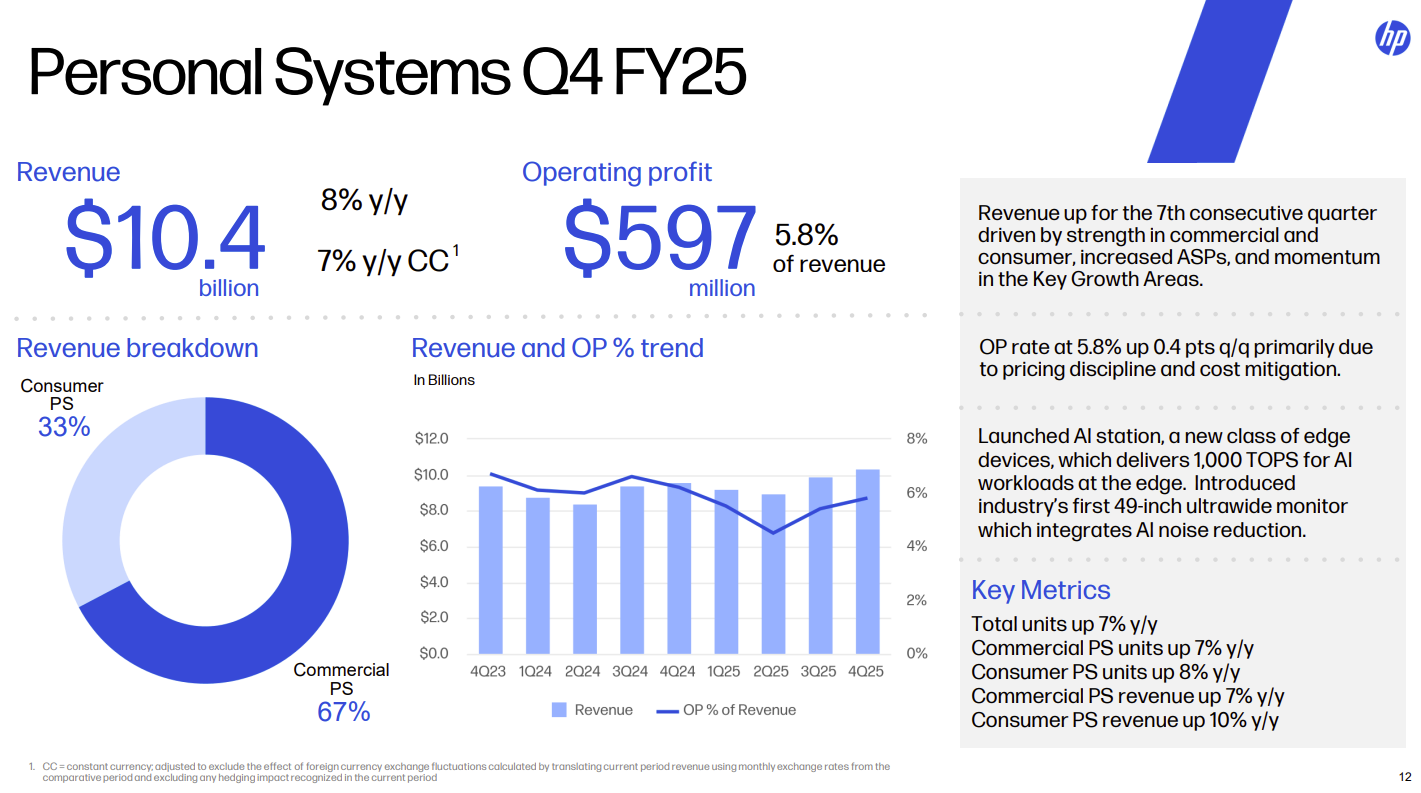
Speaking on HP's fourth quarter earnings call, Lores said the company doubled revenue for AI PCs, but the penetration of the devices sit at about 30%. The driver of AI PC upgrades revolve around being prepared for applications that have yet to show up.
"Customers want to be ready as soon as applications start taking advantage of the capabilities of these products," said Lores, who said HP is working with customers to create apps that leverage AI capabilities. Lores said that Microsoft's tools to manage PCs with voice could be a driver.
HP is hoping that being customer zero will help sell AI PCs. "We have deployed these solutions internally in HP with not only the PCs but with a curated set of applications, we have seen up to 17% of productivity improvement," said Lores.
Now HP is moving PCs. Revenue in the fourth quarter for the PC unit was up 8% from a year ago largely due to commercial and premium consumer devices.
"With 40% of the installed base still on Windows 10 at the end of Q4, the Windows 11 refresh will remain a tailwind for the PC market into 2026. And demand for AI PCs continues to accelerate, now representing more than 30% of our shipments this quarter," said Lores.
It's worth noting that Lores said the following during HP's fourth quarter call in 2024.
"We have not changed our view on the impact that AI PCs are going to have and current results support the assumptions that we have seen. The AI PCs are going to drive an improvement of average selling price. What we have been saying until now when we confirm is three years from now, we expect them to be between 40% and 60% of the mix and half around between a 5% and a 10% impact on the overall category."
"If you ask me how confident I am about the impact the AI PCs are going to have is even more than before because I have seen them in action. I see the opportunity that they bring."
But why buy a PC if we're still waiting for applications that take advantage of AI the device?
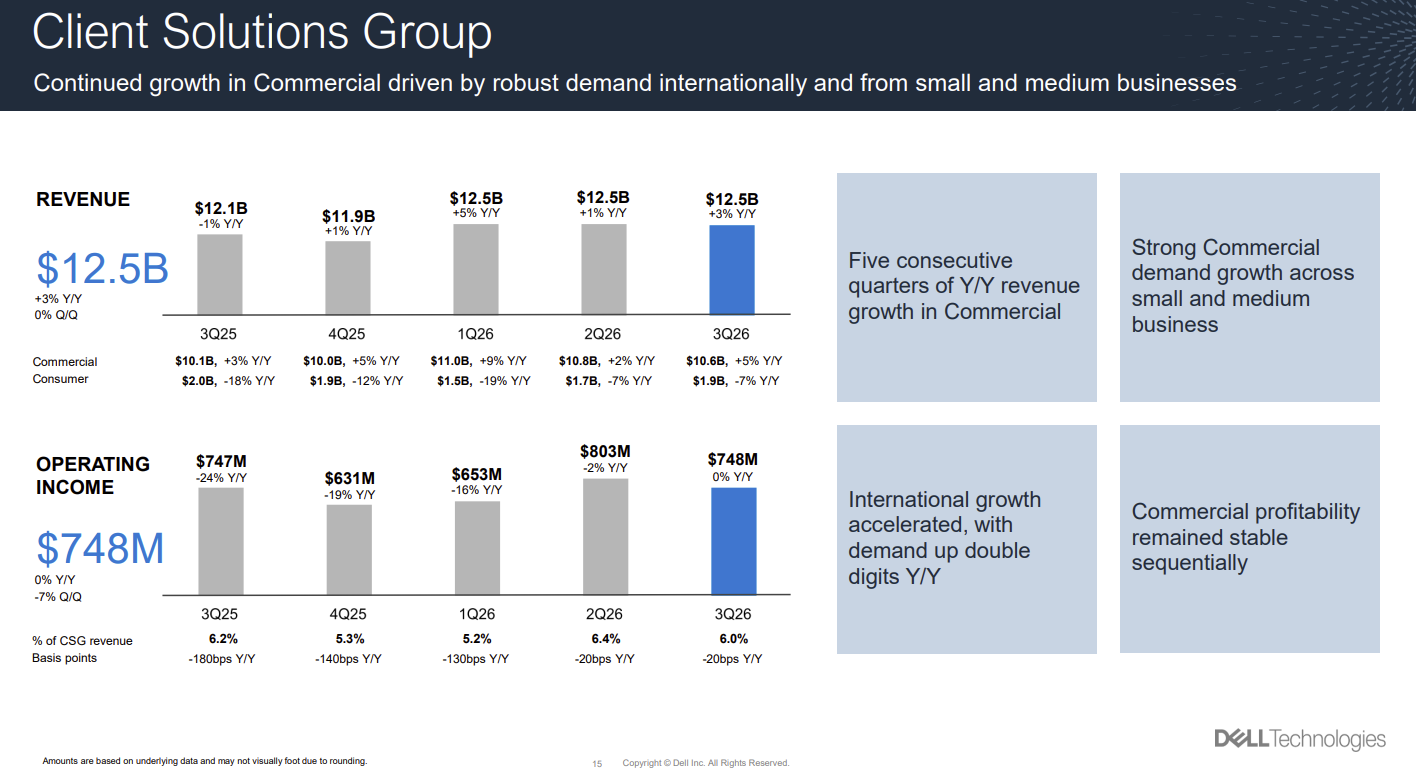
For Dell Technologies, the AI PC story is similar. The difference with Dell Technologies is that PCs are mostly commercial and the reality is Wall Street is more tuned into AI servers.
Nevertheless, there's an optimistic hurry up and wait theme with Dell's AI PCs too. Dell Technologies Chief Operating Officer said on the company's third quarter earnings call:
"We have not completed the Windows 11 transition. In fact, if you were to look at it relative to the previous OS end of service, we are 10, 12 points behind at that point with Windows 11 than we were the previous generation.
The installed base is roughly 1.5 billion units. We have about 500 million of them capable of running Windows 11 that haven't been upgraded. And we have another 500 million that are 4 years old that can't run Windows 11. Those are all rich opportunities to upgrade towards Windows 11 and modern technology.
Equally important, AI PCs, small language models, more capable applications, improvements in operating systems and their capabilities and the embedded AI there, the use of an MPU, the capability of an MPU and future PCs gives me the view that the PC market will continue to flourish going forward."
Clarke then went on to define "flourish." He said Dell is expecting the PC market to be roughly flat with a year ago.
In November 2024, Clarke said that he saw indications that customers are lining up new AI PCs in the first half of 2025. Enterprises have been upgrading as part of a normal cycle. But it's not a boom by any means. In other words, PC users should have been primed to upgrade to AI PCs a year ago. PC owners aren't rushing to upgrade.
For Lenovo, the company said AI PCS are 33% of PC shipments just ahead of HP's percentage. Luca Rossi, Executive VP & President of Lenovo's Intelligent Devices Group, said the company has more than 30% market share in Windows AI PCs.
"We are also not standing by, and we look forward to what will be the new AI native device era," said Rossi.
Rossi isn't alone. Every vendor in the AI PC market is still looking forward to the AI revolution, which apparently delayed.
My take
As someone who has been looking to upgrade by laptop for at least a year just based on the reality it's more than 4 years old, I get the delay in the upgrade cycle.
For starters, I don't see the point of an AI PC. I don't want to talk to the equivalent of what is a productivity toaster. And if I did, I could riff with ChatGPT or Google Gemini on my not-AI-PC without any issues.
Now I get the privacy argument and see how on-device models could be handy, but there's not enough value for me to upgrade.
It's a tougher sell to waste expendable income on an AI PC when there's no killer app. Toss in economic concerns, and it's no surprise the PC upgrade cycle is slow.
And Windows 11 isn't much of a sell either. My fleet of PCs were capable of upgrading so that's not rushing things either. In addition, Microsoft seems to be carpet bombing me with Copilot pitches at every turn. I generally click the "x" when Copilot tries to be helpful. AI can't stand for annoying interruptions.
Simply put, if I want Copilot I'll reach out. Otherwise leave me alone.
A year in the AI PC upgrade cycle
- HP cites strong demand for AI PCs as it beats expectations on revenue, but investors aren’t impressed
- AI PCs may decentralize inferencing workloads
- Intel launches Lunar Lake laptops, aims to scale AI PCs, spur upgrade cycle
- The real reason Windows AI PCs will be interesting
- Santa isn't bringing you an AI PC in 2024


