
TL;DR
Dashboards were built for a world where humans were the throughput constraint.
Decision loops are built for a world where machines are the throughput constraint.
Decision loops expose decision debt, eliminate inconsistency, scale judgment, and create learning systems, which is why Decision Velocity (speed × accuracy × effectiveness) is quickly becoming the new measure of AI ROI and yardstick of AI initiative success.
This article launches a larger series on how enterprises operationalize AI built from my latest research report, Decision Velocity in the Agentic Era: Architecting for Decision Automation.
AI Needs a Job Description, Not Another Playground
Enterprises have spent the past 18 months experimenting with AI. Copilots … piloted, Chatbots stitched across siloed tools, and Models with no guardrails or owners.
But boards and CFOs now demand exponential efficiency and thinking at the right scale when it comes to leveraging AI, not more playgrounds. AI needs a job description.
What decision does it own? What outcome does it drive? What guardrails apply? What context is required? What measures apply?
Dashboards can’t answer those questions. Decision loops can.
1. Dashboards Describe. Decision Loops Decide.
Dashboards were revolutionary in an era where the human was the throughput constraint. Dashboards provide visibility, KPIs, and a stable understanding of what happened.
But today, the constraint has flipped. Even as AI-augmented analytics deliver the very necessary accelerated insights, every CDAO and CAIO I speak with says the same thing:
“We don’t struggle with insight. We struggle with action.”
Signals arrive too quickly, exception scale too widely, and the market demands more.
That's why decision loops become the backbone of Enterprise AI: signal (sense/learn) → context (understand) → decision (recommend) → action → learning (refine)
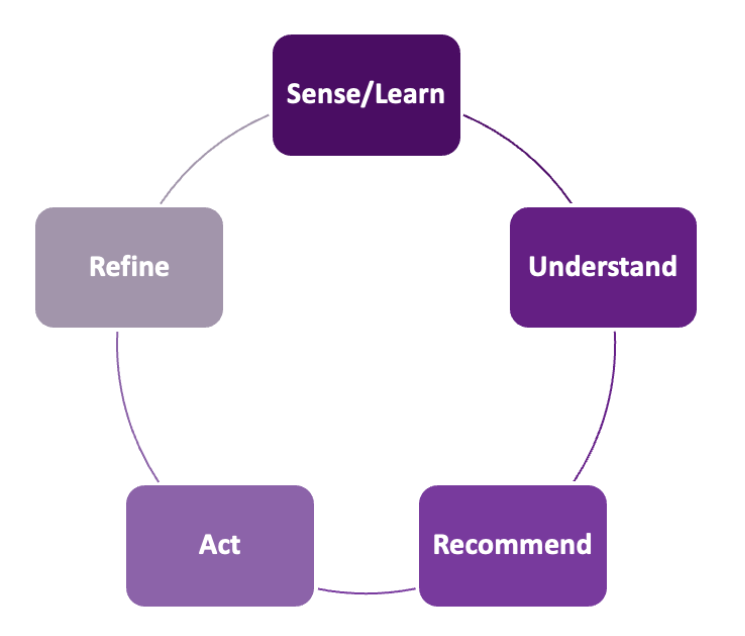
Dashboards live in one step of that loop. Enterprises need the full cycle.
2. The Real Bottleneck Isn’t Data. It’s Decision-Making.
OK, data quality is key, but most enterprises aren’t data-poor. They’re decision-poor.
The operational gap shows up everywhere: fraud signals detected too late, churn alerts ignored, supply chain delays unaddressed, pricing interventions missed, claims reviews stuck in queues, etc.
This doesn’t happen because the data isn’t visible. It happens because the decision logic is unclear:
- unclear guardrails
- tribal knowledge and rules in people's heads and "shadow rules"
- conflicting interpretations of the same metrics or understanding of what context is missing
- no clarity on what “good” looks like, or even how we measure/evaluate decision quality
- brittle rules buried in apps
Dashboards hide the problems. Co-pilots only accelerate awareness, not execution, so they don't help. Decision loops surface problems, measure it, and eliminate it.
This is the first major reframe in enterprise AI adoption. You don’t scale models. You scale decisions and the rest follows.
3. The First Wins Will Be Process Decisions Because They're Observable and Owned
Here’s what the industry is already seeing across early adopters and fast followers achieving ROI: The fastest returns come from operational decisions embedded within processes.
Whether it involves invoice matching, replenishment, credit underwriting, claims adjudication, fraud triage, or customer routing, the shift from pilots to process automation has begun.
Why? Because these drive decision automations that are:
- measureable
- repeatable
- easy to instrument
- governable
- and importantly, have clear KPIs ownable by someone
This is why “AI for operations” has already gained mindshare across executive teams, industry event stories, and dominating the early wins.
4. Governance Isn’t a Tax. It’s Runtime Infrastructure.
Here’s the shift most enterprises haven’t made, but all are discussing: Governance used to be documentation. Now it’s execution. It allows AI to move at machine speed without creating machine-scale risk.
When semantics, constraints, lineage, guardrails, and rules + models + logic is grounded in context and embedded into decisions:
- overrides become explainable
- trust scales, allowing greater automation scope
- straight-through processing increases as errors and exceptions shrink
- compliance becomes continuous
- automation becomes safe
This is one of the biggest white spaces vendors are missing to support Enterprise AI, and we see the market already moving fast to try to fill the gap first.
5. Learning Becomes the Loop
Dashboards don’t learn. Co-pilots don’t learn. Decision loops do.
Decision loops are necessarily instrumented to measure decision velocity: every override, exception, confidence score and fairness threshold, guardrail breach, every model drift … and downstream outcomes.
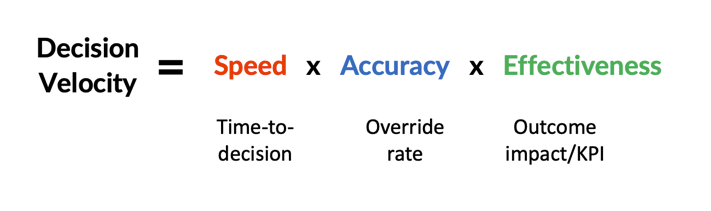
Once captured, what's critical is the speed at which the system incorporates corrections into the next decision. Telementry enables SMEs to refine the “actual” logic to use and improve rules and adjust thresholds, even as data teams tune models and evaluation/drift detection, adjust guardrails, and ultimately rethink and redesign workflows.
The loop improves … and reflects best practices to match the iterative nature of AI-driven/agentic projects.
This Article Kicks Off a Larger Arc. Follow Along.
This post kicks off a broader series on Decision Velocity describing how leading enterprises are moving up the learning curve from insights → action → governed decision automation.
Here’s some of what’s coming:
- Where to Start: Identifying Low-Hanging, High-Value Decisions
- Process Automation as the First Big Win
- Governance as Runtime Infrastructure
- Decision-Centric Architecture (DCA) blueprint that sits on top of existing systems.
- Context, Tribal Knowledge & Guardrails
- From Data Integration & Orchestration to Decision Orchestration
- Decision Loops & Observability
If you’re a CDAO, CAIO, or vendor building toward the data-to-decision stack, follow along, comment below, or better yet. connect with me and let’s discuss.
I’ll be updating this page with new content, and each part of this arc will link back here so you can jump straight into the components that matter most to you.
You can read more
- Report: Decision Velocity in the Agentic Era: Architecting for Decision Automation
- Case studies on Exponential Efficiency: “Enterprises start to harvest AI-driven exponential efficiency efforts”
- Ray Wang, “Exponential Efficiency in the Age of AI,” Destination CRM


