
Public sector technology executives laid out a series of takeaways and best practices at the Google Public Sector Summit in Washington, D.C., in October. The takeaways ranged from focusing on your data foundation to use cases for artificial intelligence (AI) agents and the importance of training and human-in-the-loop processes.
Here’s a tour of what seven public sector technology leaders had to say (PDF).
More from Google Public Sector Summit 2025:
- Google Public Sector: AI agents and the future of government
- Google Public Sector, Lockheed Martin pair up for on-premises AI
It's all about data first
Dr. Chrysoula Malogianni, Associate Vice President of Innovation at ODU: Your data is everything
Old Dominion University worked with Google Public Sector to launch MonarchSphere, a platform that weaves AI throughout ODU's student experience, research and operations.
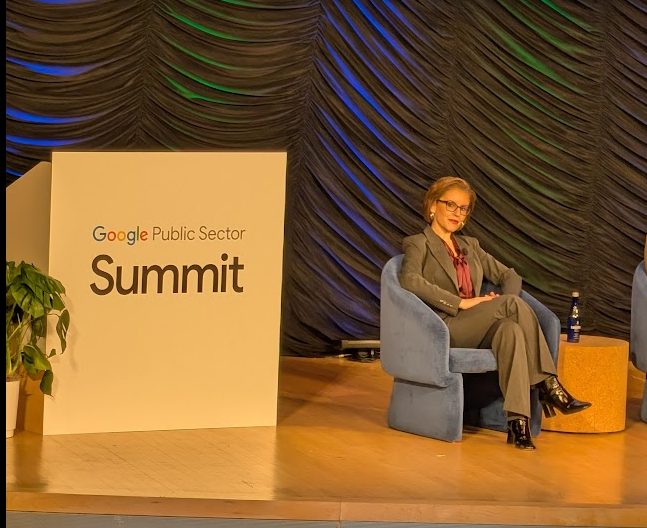
Dr. Chrysoula Malogianni, Associate Vice President of Innovation at ODU
Malogianni said your AI success largely depends on your data. “Have a data plan. AI is not a catastrophe or a panacea. AI can’t do anything. You need robust data. You need infrastructure and a data foundation so you can validate AI. You need to also start preparing your target population for AI adoption. If we don't understand the AI, you won’t have a plan.”
She added that ODU put a lot of work into the data foundation along with Google Public Sector. Among the key assets:
- 20 years of recorded courses and data that can be combined with real-time data from interactions
- Notebooks for mind maps and course outlines to create assistants with the help of instructional designers
- Data types from transcripts, advisers, and student interests
- Combined course data and public data to enable students to create personalized journeys
And don’t forget the leadership. “It’s important to have visionary leadership, because transformation doesn’t start from technology. It starts from visionary leadership, appropriate partnership, and having a good plan,” said Malogianni.
See: Old Dominion, Google Public Sector Create AI Incubator
Matthew Gunkel, CIO, University of California, Riverside: Data Governance Matters
Matthew Gunkel, CIO at the University of California, Riverside, said on a panel at the Google Public Sector Summit that he has been working with Google Workspace and Gemini to speed up code transformations, surface unstructured data, and pull together different data sources.
“On the student success side, we really had an opportunity to look at where we can do advanced forecasting and modeling and then work to really use data governance. We’ve been putting data governance in place over the last 12 to 18 months to accelerate our ability to manage a resource-constrained environment. We have a lot of classroom challenges where we don’t have seats and we have too many students. How can we forecast and plan effectively and efficiently but also communicate that back to the degree programs?”
Gunkel said the data governance strategy has enabled the university to start to deploy Gemini agents on top of broad institutional data in Google Cloud BigQuery.
Data governance has been critical, because AI requires an organization to “manage information much more closely and frequently with purpose,” he added.
“AI really is worthless without the data behind it,” said Gunkel, who noted that the university is working closely with Google on Gemini use cases but needs the data strategy aligned.
Key items for UC Riverside include:
- Improving enrollment support leveraging data and AI to inform students what degree programs are available
- Semantic data mining to leverage unstructured information from transcripts
- Automating transcript verification and using AI to deliver high-quality plans of action
Use Cases Abound
Ted Ross, CIO of the City of Los Angeles: Use Cases and Training Matter
The City of Los Angeles and Google Public Sector announced a partnership that layers Google Workspace with Gemini throughout the city’s transformation.
Speaking on a panel, Ross laid out some tips and best practices:
- Use cases are not hard to find. Ross said that in government, use cases abound for areas where AI can improve efficiencies. Information dissemination and analysis are big ones. “In emergency management, AI has the ability to synthesize real-time information from utilities, cities, counties, states, and multiple jurisdictions,” said Ross. “This information also has to be multilingual.”
- Ross added that it helps to think through AI use cases in terms of personas. “Think from the perspective of personas like the broad workforce, managers, front lines,” said Ross.
- Don’t scrimp on training. “I’m a huge fan of training and giving employees an intro to AI,” said Ross, who added that the training and use of AI are critical to employee engagement. “AI is a once-in-a-generation shift of how people are computing, and you have to train the workforce so you can launch them into the future and build AI fluency. Make the investment in training now.”

From left to right: Ted Ross, CIO, City of Los Angeles; Kenneth Zellers, Commissioner, State of Missouri; Richard Smyth, Associate Vice President of Innovation and IT Services, Georgetown University; and Tony Orlando, Managing Director, Partner, and Specialty Sales, Google Public Sector.
Richard Smyth, Associate Vice President of Innovation and IT Services, Georgetown University: Student Lifecycle Management
Speaking on a panel, Smyth said Georgetown is leveraging AI and Gemini to improve the lifecycle of students through different phases, all the way to becoming alumni.
“What we want to do is make sure we can create an experience that allows students to succeed, successfully deliver on their program, but also to become strong alumni and to give back to the university as well as to the community,” Smyth said. “We think about the touchpoints that happen all the way through that journey. Historically, those systems and processes don’t interconnect, so we’re thinking of ways that we can use Gemini and Google Workspace to connect those processes and systems to create the ultimate experience.”
Key points from Smyth about Georgetown’s approach to AI:
- “We’re focused on customer-centricity but also value.”
- Georgetown needed to interact with a wide variety of departments and teams that engage the student community.
- Training to use AI correctly was a necessity.
- Solving pain points for individuals in various departments meant that those individuals bought into the AI plan.
- Time was a big value driver. “We were going through this journey with the pilot with 60 to 80 people, and one of the things that came out was time savings. Over the course of the year, we could save $650,000 to $700,000, and that was just with the folks in the pilot program. Imagine if you scaled that across the university,” said Smyth.
Ultimately, Smyth said, the goal is to use that time savings to shift more of the focus to the student experience.
Kenneth J. Zellers, Commissioner of the State of Missouri: AI Enables Digital Services
The State of Missouri is focused on digital citizen services at the speed of business, said Zellers.
To become digital, Zellers said, AI has to be able to collapse silos. “We have 17 different departments, and our 6.2 million customers can go online and access any of them,” he said. “It’s not a facade. We’re using AI to move people to various portals. When the AI is good, it’s efficient.”
Zellers said there are multiple use cases across the state government. Here are a few:
- Bill reviews where AI can speed up the compare-and-contrast process with previous versions: “You should still go back through it, but AI saves what used to take hours and hours and compresses them to a few minutes,” said Zellers.
- Department of Revenue Answers (Dora), a chatbot that gives answers to taxpayers: There have been more than six million interactions.
- Wrangling facility management, design, and construction projects: Zellers said the goal is to use AI and data from multiple assets and construction projects and become more predictive to generate savings.
- Like other CxOs in the public sector, Zellers emphasized training and finding influencers who can lead others to use AI tools. He said the state focused on introductory AI training that included workers on every level.
“We invited people from senior level,” he said. “We invited people from frontline and administrative staff. But a lot of people forget that the administrative staff is in the middle. Sometimes they get left behind. Those are the true influencers. So, we had the initial training, and then we started getting calls because people go back to the department and talk about what they saw.”
Returns on Investment
Mansour Sharha, Innovation and Technology Director for the City of Dearborn: Build Trust, Drive ROI
Sharha said the City of Dearborn is one of the more diverse cities in the U.S., with multiple Middle Eastern countries and dialects represented.
The big use case for Dearborn was using Gemini to translate documents and assist residents. Instead of using a human agent to translate, Gemini was able to solve problems via a chatbot.
“When we started the model, we provided 10 to 15 questions that residents asked, and two years later, we’re actually addressing more than 75 questions,” said Sharha. “That provided a huge value for us in terms of staffing and efficiencies.”
Sharha said Dearborn can now use its call center for more complicated queries without adding more staff.
To deploy AI, Sharha said, he had to earn the trust of each department. “We started from the bottom up and really listened to the people who will be using the technology,” he said. “A lot of people are afraid of AI. It’s really about learning AI so you can be more efficient. We built that trust and focused as a team on providing [added value] to each department.”
Use cases include:
- Using Gemini to translate documents into different languages for citizens.
- Request-for-proposal (RFP) responses via AI. Sharha said Dearborn created a checklist of what an RFP should include, and now the process is automated at the front end. Humans do the evaluation once RFPs are culled from 30 to 50 down to a handful.
- Planning and zoning commission requests are also sped up with AI, and the approval process has gone from four to five weeks to three to five days.
Looking ahead, Sharha said, Dearborn has plans to leverage AI for police and fire data and analytics.
Marcie Kahbody, Deputy Secretary of Technology and Agency Information Officer, California State Transportation Agency: Human in Loop
The California State Transportation Agency (Caltrans) has terabytes of siloed data that’s hard to get to but nevertheless a big asset. Caltrans collects data from 39,000 ground detectors, transportation management systems, and 3,000 cameras. The plan is to use that data to support the Caltrans vulnerable roadway users (VRU) plan, designed to end road fatalities and serious injuries on California roadways by 2050.
The agency started a pilot with Google Public Sector focused on wrangling the data and using it to improve safety. “We started with a sandbox so we don’t put any personal identifiable information (PII), and then we started sharing it with Gemini,” Kahbody said.
Caltrans conducted risk assessments, ran proofs of concept (POCs), and laid out needs with cybersecurity professionals, she added. Today Caltrans engineers and analysts can look at California Highway Patrol collision data to remediate high-collision areas in minutes, compared with a few days before.
"With VRU, it’s now just a click of a button to analyze,” she said.
However, you need humans in the loop in processes. “We always have a human in the loop. The engineer looks at the data closely to make sure that it’s valid and there’s no hallucination,” said Kahbody. “It’s saving us a lot of time and provides more time for our engineers to do the tasks that are more valuable.”
The project will move to production in January, she said. Reports will include recommendations to make roads safer, including better traffic signals, pedestrian lines, and areas that could be remediated. The returns will be measured in decreases in road fatalities and injuries.
Going forward, Caltrans will be launching a series of POCs and moving them into production. “We serve 23,000 employees,” said Kahbody. “Communication and change management is huge. We had a lot of communication with the unions, labor relations, and legal folks to understand that AI is not replacing anybody. Our strategy is providing tools to help engineers do a better job so they have more time to be strategic.”


