Qualcomm CEO Amon: AI will be all about generating tokens for least amount of power
Qualcomm is looking to ride the next phase of AI infrastructure--the transition from training to AI inference.
The company, which recently launched AI accelerators for data centers, fleshed out a few details about the plan on its fourth quarter earnings call. Qualcomm is planning to lay out more about its AI and data center strategy at an upcoming event in early 2026.
- Qualcomm outlines AI accelerators, eyes inferencing
- Qualcomm outlines cloud to edge vision for AI
- Qualcomm acquires Alphawave for $2.4 billion
CEO Cristiano Amon said Qualcomm's acquisition of Alphawave was a part of a broader effort to diversify. "We are incredibly excited about the size of the opportunity in the next phase of data center build-out where there's going to be real competition as we go from training to inference," said Amon.
Amon added:
"We have one very strategic asset in the industry, which is very competitive, power-efficient CPU. That is both for the head node of AI clusters as well as general purpose compute. And then we also have been building what we think is a new architecture dedicated for inference.
I think it's all going to be about generating the most amount of tokens with the least amount of power, and that's our right to play."
Qualcomm's point is already playing out. If you consider what AWS is doing with its upcoming Trainium3 chip and Google Cloud's TPU the key phrases are often performance per watt and leveraging commodity chips that scale.
In addition, AMD and Intel are also eyeing inference as larger AI markets that will arise. Nvidia, best known for horsepower and training, often notes that its GPUs are also used for inference workloads.
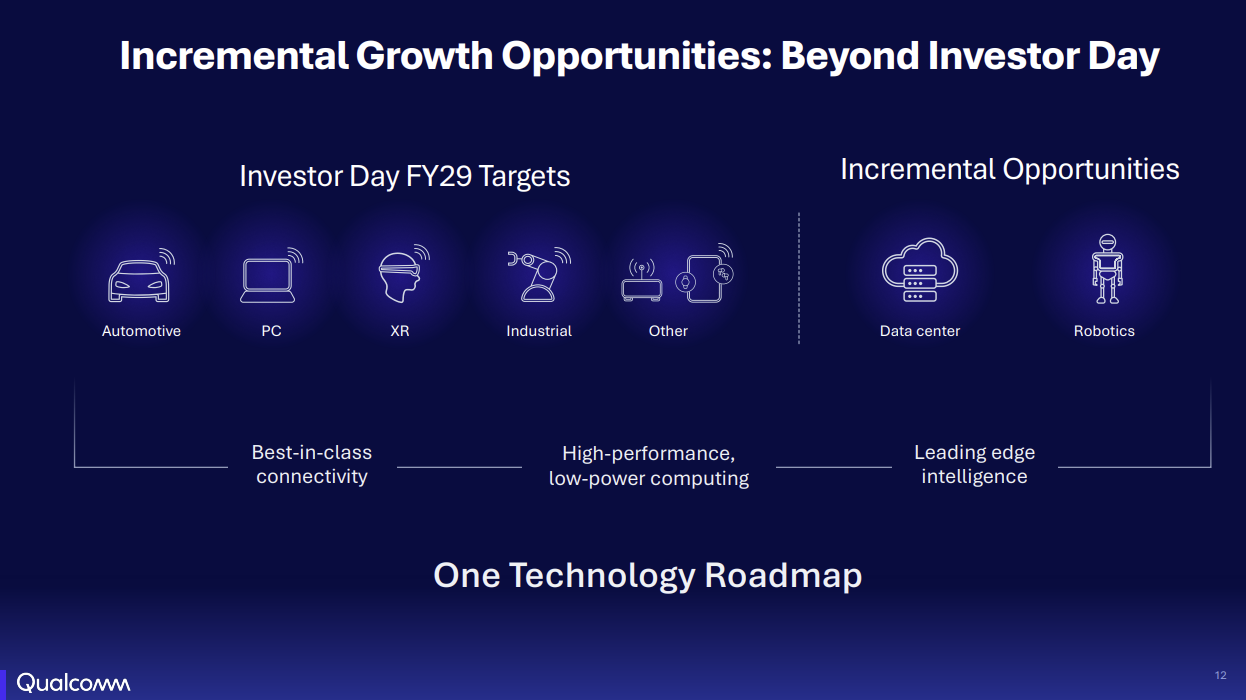
Amon said Qualcomm is in discussions with hyperscalers and designing its AI200, AI250 and all the parts that go with it. More details will be outlined early in 2026.
Key points about Qualcomm's AI accelerators:
- Data center product revenue is projected to ramp in fiscal 2028, but the HUMAIN engagement is likely to pull sales forward to fiscal 2027, said Amon.
- Qualcomm is getting interest in its data center efforts. The biggest reason? Power constraints. "We're thinking about what the future architecture should look like. We've thought about this for the edge as well, which means dedicated inferencing clusters," said Amon. "The goal is to have the highest possible compute density at the lowest possible cost and energy consumption to generate tokens. There may be an architecture beyond the GPU."
- For now, Qualcomm is walking a line between saying too much and too little about its AI data center plans. Luckily for Qualcomm, the core business is doing fine.
Qualcomm's fourth quarter earnings and revenue topped expectations as did its first quarter outlook. Qualcomm reported non-GAAP earnings of $3 a share on revenue of $11.27 billion. Wall Street was expecting fourth quarter non-GAAP earnings of $2.87 a share on revenue of $10.76 billion.
In the fourth quarter, Qualcomm's handset revenue was up 14%, automotive up 17% and IoT up 7%.
For fiscal 2025, Qualcomm reported net income of $5.01 a share on revenue of $44.28 billion, up 14% from a year ago. Qualcomm's fourth quarter and fiscal 2025 results included a non-cash charge of $5.7 billion due to tax law changes. Qualcomm had to establish a valuation allowance against its deferred tax assets.
As for the outlook, Qualcomm projected first quarter revenue of $11.8 billion and $12.6 billion with non-GAAP earnings of $3.30 a share to $3.50 a share. The company saw strength in its chips for smartphones, notably Android premium devices, and combined automotive and IoT fiscal year revenue jumped 27%.
Larry Dignan is Editor in Chief of Constellation Insights at Constellation Research, where he leads editorial coverage focused on enterprise technology, digital transformation, and emerging trends shaping the future of business. He oversees research-driven news, analysis, interviews, and event coverage designed to help technology buyers and vendors navigate complex markets with clarity and context. ...
Read morePublished
Author